Hula! The Tokyo stock! Great piece! Is that there are many things to do in Tokyo! And I saw lots of stuff. I guess I'll forget some things, but hey, I think with all the guidebooks that exist in this city, you will not have trouble finding what you are missing here.

WHAT see in Tokyo?
As often happens in Japanese cities, neighborhoods are organized around the means of transportation, trains and subways.
In this case to Tokyo we usually speak of an 'empty center', referring to the imperial palace and its garden, located in the center of the city. Neighborhoods are organized in circles around this center, which is well represented by the line of the JR Yamanote train line, which surrounds the center and can go through all the main tourist areas of Tokyo. So take a ticket for the Yamanote and do a complete permit must already have an idea of the city.
The atmosphere in some neighborhoods is an attraction in itself: it has seen with his youth Harajuku and sassy, with neon nightclubs of Shinjuku or the quiet streets of Yanaka ... Tokyo is a city of a thousand faces. So we baladons
from neighborhood to neighborhood:
Center:
I did not visit any place in downtown Tokyo this time, but it is not without interest ...
- The Imperial Palace: Residence of the Emperor, and thus closed to the public, but you can stroll through the gardens, watching the walls and bridges. (Garden Palace: 9h to 16h - closed Friday and Monday)
- The Yasukuni jinja shrine located next to the zen palace. Dedicated to Japanese war dead, controversial because it contains within it the graves of war criminals, however, it is very beautiful. There is also a small museum.
- Tokyo Station: The exterior of the building has kept its architecture of the Meiji era.
- Ginza: This is the oldest upscale neighborhood of the capital. Wide avenues filled with luxury shops. I suggest you go for a ride on the roofs of department stores in the neighborhood who are the oldest in Japan. Note that on weekends, the neighborhood streets become pedestrian.
South:
- Tokyo Tower (9h to 22h - 820 yen): Well of course, compared to our national Eiffel Tower, it does not look: red-painted white, surrounded by buildings taller than she, and holding between its legs a square building hideous. But I remember having spent some time at sunset during a previous trip.
- Roppongi, another place for nightlife packed with bars and clubs, also known for building the Roppongi Hills, filled with shops and restaurants ...
- Tsukiji (24/24 - free admission): A place not to miss the biggest fish market in the world! Fish of all kinds, from the bizarre to the most common. The most impressive is the tuna, big fish lined up in ranks by hundreds, and cut or saber saw. The must is to go there before 7am (so much for sleeping in). Local restaurants are well on the freshest sushi in the capital. (Note: do not think that after the visit, you'll feel the fish all day. Here, the fish are ultra cool.)
Farther south:
- Odaiba : A ride on this large artificial island may be of interest, starting by taking the monorail running through the great Yurikamome Rainbow Bridge. We can then visit the shopping complexes theme: Venus Forte, Italian architecture, and Decker, whose decor is reminiscent of old Japan. One can also go around the wheel, or else walk on one of the few beaches in Tokyo, along with the Statue of Liberty. Complex Oedo Onsen Onsen Monogatari (2700yen 11am to 9am) can also be an option.
In the West:

Like me, take a nice walk one day in one of the nicest neighborhoods of Tokyo, on Sunday, preferably. In chronological order:
- Visit Tokyo Camii : Off the beaten track, a superb brand new mosque. Type of building you would not expect to find in Tokyo (Metro Yoyogi Uehara).
- Strolling in Yoyogi Park : very pleasing to see so many trees for its relaxed atmosphere for reigns, each engaged in Tokyo's hobby. For example Dog Run, romp where do the doggies and their Japanese masters.
- Observe dance hooligans : The entrance of Yoyogi Park is the gathering place of those nostalgic for the good old days of Rock'nRoll.
- Play the many street musicians who improvise concerts around the park. There is plenty of choice ...
- Bypass Olympic Stadium by Kenzo Tange , with its unique architecture. Go
- be photographed in the company of Harajuku girls in their outlandish costumes.
- Go Omotesando Avenue can be stopped at one of its cafes, or in shopping malls and stores: Omotesando Hills, Laforet and the Oriental Bazaar to buy souvenirs.
- Lunch: real crepes at the restaurant Le Bretagne .
- Cultivating before the works of artists from the Design Festa (free admission - 11h to 20h).
- Browse the streets of Aoyama , art galleries and designer boutiques.
- You can not go back without the little Harajuku Street Takeshita dori , where is the clothes shop the most original of the capital ... and the customers that go with it!
- Unfortunately I could not go to the Meiji jingu shrine (open from sunrise to sunset-free): built in honor of the Emperor Meiji, known for its huge torii.
- Shibuya, the fashion district is not far away. And if like me you do not plan redo your wardrobe, you can go say hello to Hachiko , the most faithful dog in the world.
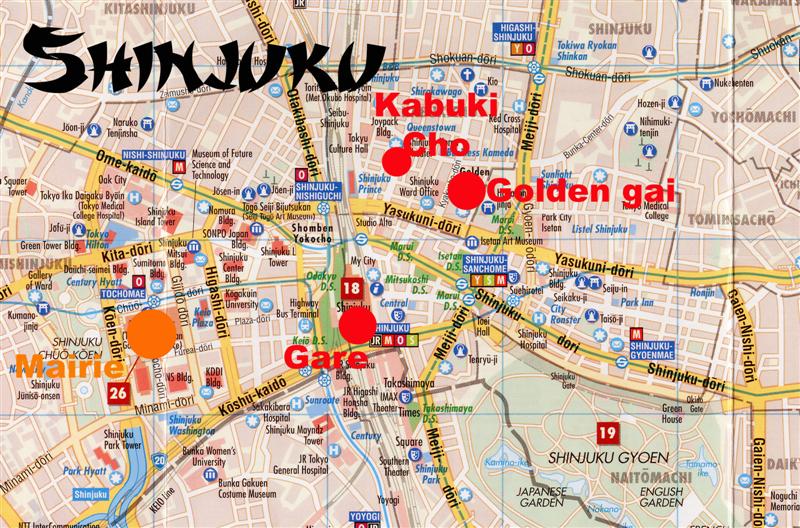
- Shinjuku and neon: a unique atmosphere to enjoy especially at night, in strolling on Yasukuni dori. Not to be missed of course.
- Golden gay: I like this neighborhood, its streets with an intimate and somewhat sordid ...
- cho Kabuki: The Other Face of the night: sex, bars hostess. To ensure that the Japanese are not always wise ...
- The mayor of Tokyo: To the west of the station, is the studious side of Shinjuku. This is where the headquarters of the Tokyo city hall, 2 huge twin towers built by Kenzo Tange and surrounded by a cluster of other buildings. It should absolutely go to the viewing platform of the towers to have a unique perspective on the city (9.30-22h, various times, free).
the North West
- Ikebukuro Sunshine City and (Bridge Observer: 10am 21.30 - 620 yen) was in the beginning of the trip, visiting this building with views of Tokyo at night. The building itself did not really packed. This is a neighborhood best known for its shops (one more).
the North East

- Tokyo Dome and amusement park (10 to 22? - Price depending on the carousel): I did not have time to do a ride but with city views, it can be fun. We'll do that next time. We will perhaps even see a baseball game at Tokyo Dome ...
- Koishikawa Korakuen (9h to 17h - 300yen): Beautiful autumn garden, and I imagine in other seasons too. Unmissable.
- Ochanomizu , the area of music: With its musical instrument shops, bookstores and cafes, a nice student district.
- St Nicolai : A curiosity: a true Catholic Orthodox Cathedral, right in Tokyo. Even if I could not enter (doors closed to dusk), the place is quite impressive and worth a visit.
- Akihabara: A neighborhood dedicated to electronics and technology, with lots of stores at bargain prices, but also the neighborhood of manga fans and cosplay-bars.
Going a little further west, one comes across the district Iidabashi / Kagurazaka, with the channel cafe (where I went early in the trip), but also Institute Franco Japanese (with its media and its brewery. Various events are held). It is said that this would be very nice area of Tokyo's French Quarter.
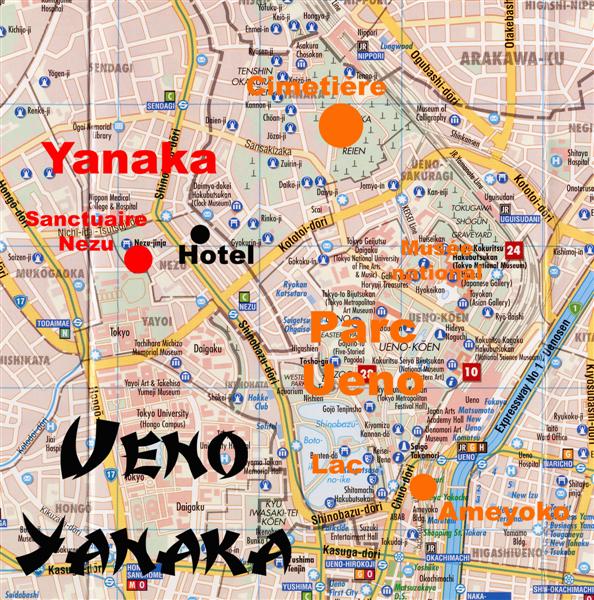
- The old quarter of Yanaka , with its quiet old houses, offers a pleasant ride. Some traditional shops, the quiet sanctuary Nezu, the Cat House .
- Ueno Park and its many attractions: Usually I go there but I have not had time. It is a great park with a lake at its center. In spring the park is taken over by the Japanese came to see the cherry blossoms. Flowering water lilies from the lake also offers a very good show. Several temples. With some bonus interesting museums: the National Museum (9h30-17h or 20h, 420Yen, closed on Mondays), a must if you're interested in the history of Japan and Japanese art (armor, Ainu pottery, prints, screens ...), the museum Western Art (9.30-17h, 420yen, closed Mondays) with works by Rodin, Van Gogh, .... There's also the small museum Shitamachi (9:30 a.m. to 4:30 p.m., closed on Mondays), which is an interactive life of a poor neighborhood in the Edo period.
- Ameyoko: These are 'smart' in Tokyo. There is virtually something for not very expensive (food, watches, bags, jeans, etc ...) with a single street entertainment. I regret not going there this time. The area has flourished under the American occupation with the black market and small shops that are installed under the railway tracks ...

Ryogoku / Asakusa, two areas known to be the cradle of traditional Japanese culture in Tokyo. Although they are now highly urbanized, one can still find some traces of the past.
At Ryogoku:
- Edo Tokyo Museum (10h to 18h - 600 yen, closed Mondays): A museum built in order to plunge us into the world of samurai and the Meiji era. It will appeal to even those who are not very adept museums.
- Ryogoku Kokugikan : This modern building houses one of the most famous stadium, sumo in Japan, and a small museum at the Sumo (10am to 16:30, closed on weekends). You can book a ticket to a tournament, but check before that sumo wrestlers are not on tour championship.
- Go take a sumo training can be a more attractive option than a game. Some beya therefore welcome visitors. You can approach the mastodons closely, to see them sweat and breathe. To have already seen I can say that's pretty impressive.
A Asakusa:
- The temple Senso ji (6h-17h) must be called, is always full of tourists. After crossing the main gate guarded by two guardian gods, one crosses his path lined with traditional shops. The temple is not bad but compared those Kyoto ...
- The amusement park is an old park Hanayashiki backed the temple. I've never been there but it seems that its old world charm of old park of the 60 is worth the detour.
- How about a stroll on the banks of the Sumida River, overlooking the Asahi building and its yellow cloud?
Day trips outside of Tokyo:
- Ghibli Museum, Mitaka in (1000 yen): Visited during my previous trip, a whole museum for the characters cartoons from the studio of Miyazaki. Do not expect a theme park, but it is a museum that will delight both children and parents. Warning: The seats are not sold on the spot, must be booked in advance. Any explanations here .
- The throat of Nishizawa : Well, even if the trees were a little bare, I admit that this hike off the beaten tourist was a great time to discover the nature of the Japanese mountains. I recommend it!
- Fuji Go Ko : located at the foot of Mount Fuji 5 lakes area offers an exceptional view of the sacred mountain.
- Climbing Mount Fuji: Not because it is only practiced in the summer and requires little preparation.
- Hakone: Another lake where you can see Fuji san, but less so than in the region Fuji Go Ko known for its onsen, I suggest you take a romantic train Odakyu line, to the circuit in the cable car in the mountains of Hakone, followed by the field of fumaroles, then across the lake on the fake pirate ships. Do not forget to visit the onsens. It's been very 'Circuit for tourists, but it's quite enjoyable.
- Kamakura: The ancient capital of Japan is known for its numerous temples and a beach for surfers. I recommend the Zeni Arai Benten temple, where we just wash his money, and of course the great bronze Buddha.
- Yokohama: This is the city of Tokyo, so great that the two cities meet. Known for its Chinatown filled with restaurants quite expensive, with its neon supposed to think about China, and a small temple at the center. This is not my favorite spot and I prefer the waterfront of the port reached with minato mirai and Landmark Tower, tallest tower in Japan where I remember having watched the sunset. I also remember Motomachi and Yamate , a neighborhood in height with residences of foreign diplomats from 1860: France and the cemetery yama foreigners. Ca I really liked.
- Nikko: I stayed two days, but it is possible to make a day trip in this small town in the mountains.
HOW go to Tokyo?
- By train: Of course, all of the Shinkansen leaving Tokyo Station central enough, those of Shinjuku and Ueno are also quite important.
- By plane: The airport at Narita, where there are most of the international aircraft, is located quite far from Tokyo. I'm not sure the bus or taxi ride is worth the shot. Cons by train, there are several choices: If you want to use your JRPass directly, you can have it validated at the airport and take the Narita Express (1h-2940yen or JRPass). There is also the JR Rapid Service (1:30). I prefer the Keisei Skyliner (1h - 1920 yen) is going to Ueno.
HOW get around Tokyo?
- With the JR Pass: You can use the JR Yamanote line, but it handy in my opinion will not allow you to go anywhere. It will then alternate with the subway.
- By Metro: There are several companies with the opportunity to purchase passes for the day. No problem all the stations are written in Roman alphabet. Read my post on the subway to the use of tickets. The 1-day ticket valid on all subways worth 1000yen.
- By taxi: I've never tried but you see everywhere. It can help if troubleshooting.
- Cycling: It might be nice but Tokyo is still a big city ...
OR sleep in Tokyo?
I leave you a whole bunch of other addresses below
HOW does it cost to Tokyo?
Train: Free with JRPass
Airport shuttle: 2 x 1920 = 30 yen
€ Metro: subway maps for the day : 4 x 1000 Yen = 31 € without breakfast
Ryokan: 4x 5355 + € = 167 yen to 315 yen Pdj
Edo Tokyo Museum: 600 yen = 5 €
Korakuen: 300 yen = 2 €
rides Nishizawa: 2040 yen = € 15
Fuji Go Ko Excursion to: cable car and bus: 1700 yen = 13 €
Roppongi Hills: 620 yen = 5 € Add
restaurants and various foods.
And of course lots of small purchases to: trinkets, sdcard ... There are so many temptations!
Websites:
General
The Tokyo Pocket Guide
The site Yokohama
Travel: Airport
Narita
The Keisei Skyliner
Metro Tokyo
Housing:
Try the night in a capsule hotel
The Kimi ryokan
Sadachiyo more expensive hostels
2: Sakura house and Tokyo International Hostel
A ryokan-looking design, Andon
The New koyo
The Juyoh
hotel The hotel the city children
The business hotels of the chain Toyoko
A little more luxurious, sutton place
Homeikan , a true ryokan in Tokyo full.
name of a sushi! Never laid an article as long!


0 comments:
Post a Comment